
Introdução: mensuração, premissas e o espectro de risco regulatório
Ao auditar os dados necessários para o teste de qualidade da água compendial, um número de aprovação por si só não é suficiente de acordo com as BPF. As inspeções ou auditorias da FDA coordenadas pela EMA, COFEPRIS ou outras agências reguladoras se aprofundam, querendo ver você entender seus dados, não apenas atender aos mínimos.
No caso de medições de carbono orgânico total (COT) e carbono inorgânico (IC), o método de análise para liberação de água ultrapura (UPW) e água para injeção (WFI) pode determinar se os resultados de uma auditoria se enquadram em uma designação de alto ou baixo risco. Simplificando, as suposições colocam você no espectro do risco regulatório. Apenas evidências diretas são defensáveis.
O que é escrutinado em uma auditoria de BPF?
No caso de uma auditoria de BPF (Boas Práticas de Fabricação), os reguladores examinam todo o seu ecossistema de fabricação para verificar a conformidade com rigorosos padrões de qualidade e segurança. Conhecida como os "Cinco Pilares das BPF", uma auditoria pode ter como alvo o seguinte:
- Procedimentos e Documentação: Procedimentos operacionais padrão (POPs), registros em lote, trilhas de auditoria, integridade de dados
- Pessoas: Funcionários, registros de treinamento, compreensão e aderência de processos
- Instalações: Instalações, incluindo controles e manutenção ambiental, HVAC e armazenamento com temperatura controlada, limpeza e controle de pragas
- Processos: Avaliação da validação do processo para garantir que o método de fabricação entregue consistentemente os resultados esperados; revisão de controles de alteração e logs de desvio/CAPA (Ação Corretiva e Preventiva) para ver como você investiga e corrige problemas
- Produtos: Ingredientes materiais, produto final, testes e rotulagem
Instrumentação para testes de qualidade da água farmacêutica
Os sistemas UPW e WFI são pontos focais garantidos de uma auditoria completa, e os instrumentos analíticos que medem parâmetros relacionados aos sistemas de água podem esperar níveis iguais de escrutínio. Específico da instrumentação analítica, o escrutínio visa inevitavelmente o método de medição, bem como os dados.
A escolha da tecnologia para medir o COT e as limitações potenciais de suas capacidades de medição de carbono podem representar um problema sob a pressão de uma auditoria de BPF, especialmente se for difícil defender os resultados devido à sua falta de especificidade de carbono. Entender a diferença de tipos de carbono – orgânico vs inorgânico – é imperativo e deve ser levado em conta muito antes de uma inspeção.
Os auditores avaliam os laboratórios fazendo perguntas detalhadas sobre os métodos de coleta de dados e como os resultados são gerados e registrados. As perguntas de exemplo abaixo espelham o que você provavelmente ouvirá durante uma auditoria. Reserve um tempo para respondê-las criticamente. Este exercício ajudará você a avaliar se seus instrumentos e métodos de teste atuais produzem os registros em lote confiáveis e defensáveis que os auditores esperam ver. Se você identificar pontos fracos agora, poderá resolvê-los antes que um auditor o faça.
Demonstrando a especificidade do carbono
Questão 1 do auditor: "Como você demonstra a especificidade do carbono?"
Essa pergunta muitas vezes cria tensão durante as inspeções, e por um bom motivo. Há uma diferença fundamental entre medir o carbono real e estimar sua presença por meio de sinais secundários.
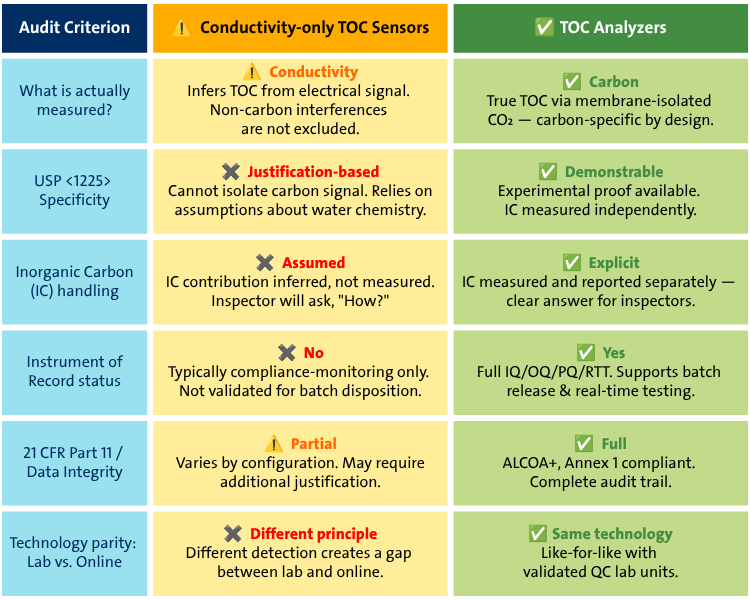
Sensores somente de condutividade medem a mudança iônica total em uma amostra. O problema? Esses sensores não conseguem distinguir entre carbono orgânico e íons inorgânicos, como cloretos ou nitratos. Quando um inspetor pede prova da especificidade do carbono, um sensor de condutividade oferece apenas uma suposição – que nenhum íon interferente estava presente. Essa suposição cria uma lacuna crítica em sua trilha de dados, e as suposições não se sustentam bem sob o escrutínio da auditoria.
Existem instrumentos analíticos em um espectro de risco regulatório. Na ponta de alto risco, sensores somente de condutividade criam vulnerabilidades de auditoria significativas. Quando os auditores questionam seus métodos ou desafiam seus dados, esses sensores são difíceis de defender. Na ponta de baixo risco, analisadores de carbono prontos para auditoria fornecem uma história diferente. Eles fornecem dados defensáveis e rastreáveis que protegem seus registros de lote e resistem ao escrutínio regulatório.
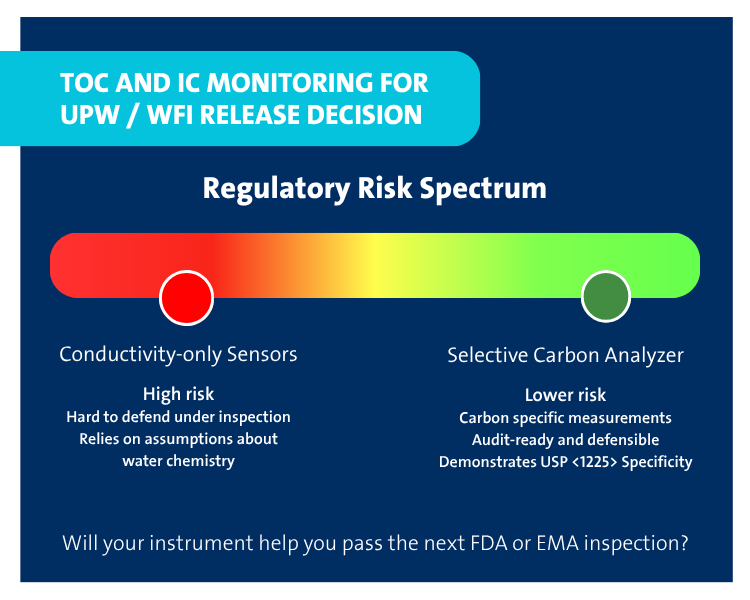
Instrumentos projetados para isolar carbono na forma de CO₂ antes da análise obtêm uma medição precisa do COT. O isolamento físico do carbono dos íons antes da detecção garante a especificidade como um fato químico demonstrável, não meramente teórico. Isso estabelece uma trilha de dados ininterrupta desde a química inicial até o registro eletrônico final. Quando os auditores perguntam como você sabe que é carbono, você pode mostrá-los, não apenas dizer-lhes.
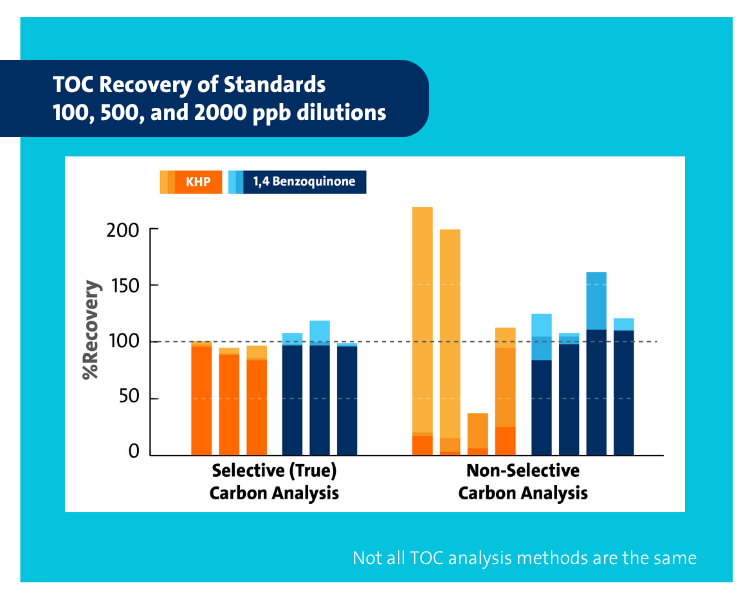
Quer saber mais ou ver dados de compostos de desafio adicionais?
Faça o download do nosso guia de tecnologia de COT.
Medição de carbono inorgânico
Pergunta 2 do auditor: "Como o carbono inorgânico é contabilizado?"
O manuseio de carbono inorgânico (CI) é um alvo frequente de questionamentos profundos. Quando os inspetores da FDA ou do COFEPRIS investigam esta área, eles estão procurando ambiguidade. Se o seu instrumento infere carbono inorgânico, você é forçado a fornecer uma longa justificativa que pode entrar em colapso sob escrutínio.
Vamos comparar:
Análise de carbono seletiva ou verdadeira
Medição direta: o carbono inorgânico é medido explicitamente e relatado independentemente para obter uma trilha de dados clara.
Defesa de auditoria: fornece medições baseadas em dados que minimizam a necessidade de perguntas adicionais.
Sensor de condutividade
Contribuição inferida: o carbono inorgânico é assumido com base na condutividade total, exigindo uma justificativa teórica, não baseada em dados.
Risco de auditoria: é provável que o inspetor investigue a validade dos pressupostos, aumentando a duração e o risco da auditoria.
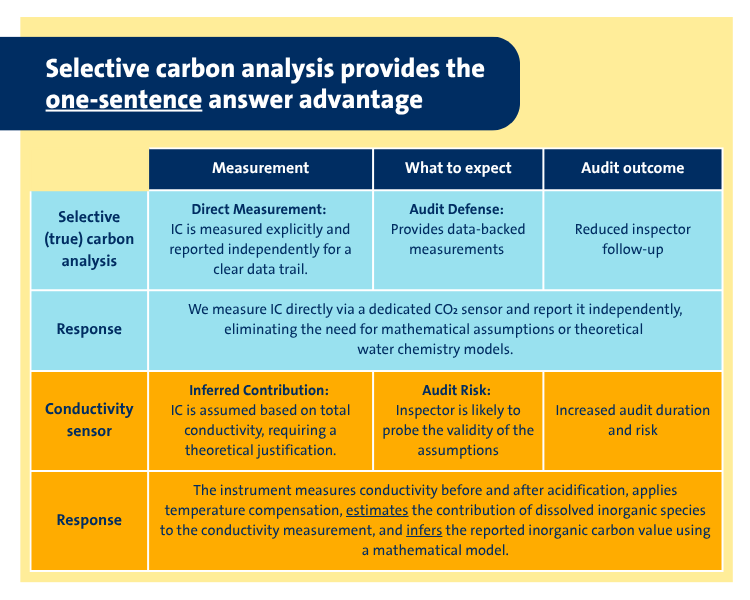
A análise seletiva de carbono fornece uma resposta clara e simples de uma frase:
"Medimos o carbono inorgânico diretamente por meio de um sensor de CO₂ dedicado e o reportamos de forma independente, eliminando a necessidade de suposições matemáticas ou modelos teóricos de química da água."
Instrumento de registro para monitoramento compendial da qualidade da água
Questão 3 do auditor: "Este pode ser o instrumento de registro?"
Para servir como um "Instrumento de Registro", um analisador deve fazer mais do que monitorar tendências; deve satisfazer os mais rigorosos requisitos de validação (IQ/OQ/PQ) e testes em tempo real (RTT) e aderir estritamente aos princípios de integridade de dados da ALCOA+.
Aqui está uma questão crítica que muitas empresas ignoram: alguns fabricantes de instrumentos usam tecnologias analíticas completamente diferentes para testes on-line em tempo real versus análise de amostras em laboratório. Por exemplo, eles podem usar um sensor de condutividade para monitoramento on-line de ciclos de água, mas um analisador baseado em combustão no laboratório de CQ. Quando uma mesma amostra produz resultados diferentes, dependendo da tecnologia testada, você enfrenta um problema significativo durante as auditorias.
A Veolia adota uma abordagem diferente. Nossos sistemas Sievers usam a mesma tecnologia de detecção de condutividade baseada em membrana para análises on-line e laboratoriais. Essa paridade tecnológica elimina a variabilidade analítica que ocorre quando diferentes métodos de detecção são aplicados à mesma amostra. Se você está monitorando continuamente em seu loop WFI ou validando amostras no laboratório QC, você está usando o mesmo método analítico.
Por que isso é importante? Durante uma investigação fora da especificação (OOS), as incompatibilidades tecnológicas criam sérias complicações. Se o seu instrumento on-line usa princípios de detecção diferentes do seu instrumento de laboratório, os auditores pedirão que você justifique por que os resultados não se alinham. Isso coloca você em uma posição complexa e de alto risco, em que você está defendendo diferenças de metodologia em vez de discutir a qualidade real da amostra. Quando ambos os instrumentos usam tecnologia idêntica, seus dados contam uma história consistente e defensável do sistema de distribuição de água ao laboratório de controle de qualidade.
USP <1225> Validação de procedimentos de compêndio
Questão 4 do auditor: "Qual é a sua lógica de especificidade USP <1225>?"
De acordo com a USP <1225>, o regulamento relativo ao desenvolvimento e validação de procedimentos analíticos, a distinção entre especificidade baseada em método e especificidade baseada em justificativa é primordial e pode ser a diferença entre uma auditoria segura e um interrogatório técnico.
Os sensores de condutividade dependem da especificidade baseada em justificativa. Como eles não podem isolar o sinal de carbono, eles se baseiam na suposição de que o sistema de água é estável o suficiente para que íons não-carbono não interfiram. Em um ambiente de BPF, esse raciocínio teórico, não baseado em fatos, é uma responsabilidade.
Analisadores de COT como o Sievers M500 e o Sievers M9 alcançam a especificidade por meio do próprio método de medição. Esses instrumentos usam uma membrana permeável a gás que permite que apenas CO₂ chegue ao detector, excluindo compostos interferentes antes que a detecção ocorra. Isso significa que você não precisa justificar as suposições de química da água para um auditor. A tecnologia já eliminou possíveis interferências como parte do processo de medição.
Espera-se cumprir a linha de base da USP <643>, UPS <1225> e USP <1226> é esperado. No entanto, fornecer um sinal específico de carbono demonstrável experimentalmente é o que fornece verdadeira proteção de lote e prontidão para auditoria.
Conclusão: conformidade através de dados defensáveis
A conformidade da USP é o mínimo. A defensibilidade da USP é o objetivo.
A principal defesa contra falhas de auditoria é a seleção de um instrumento que forneça medição de carbono específica e integridade de dados inatacável. Ao ir além dos requisitos mínimos de conformidade com a USP, você pode fornecer respostas baseadas em dados, em vez de narrativas baseadas em suposições.
Os analisadores de COT, como o Sievers M500 e o Sievers M9, atendem aos seguintes padrões regulatórios para total tranquilidade:
- USP <643>, <1225> e <1226>
- Método alternativo da FDA ASTM E2656-10
- 21 CFR Parte 11 & Anexo UE 1 Padrões Completos de Integridade de Dados ALCOA+
- Defensável para inspeções da FDA, EMA e COFEPRIS
Seu método de COT orientado a dados e está pronto para auditoria?
Baixe o guia de tecnologia de COT para descobrir.
Autores:
- Fergus Keenan
-
Fergus é um químico analítico que se tornou líder de produto, construindo e comercializando instrumentos científicos em aplicações, vendas, marketing e gerenciamento de produtos. Ele já trabalhou em várias empresas operacionais da Thermo Fisher Scientific e Danaher, bem como em uma empolgante startup de espectrometria de massa com sede em Denver chamada Exum Instruments.
- Sidnei Jannetta
-
é gerente de Marketing na Veolia, com foco na linha de instrumentos analíticos Sievers. Sydney tem apoiado os clientes da Sievers nos últimos dez anos com experiência em aplicações de carbono orgânico total (COT) e endotoxinas. Ela forneceu serviços de desenvolvimento de métodos e testes de viabilidade para fabricantes farmacêuticos e apresentou em mais de 20 conferências nacionais. Sydney é bacharel em Química pela Universidade do Colorado do Norte.
- Lindsey Wohlman
-
é especialista de Marketing na Veolia e oferece suporte à linha de instrumentos analíticos Sievers. Ela colabora estreitamente com engenheiros, cientistas e especialistas em produtos para desenvolver conteúdo que transforma informações técnicas em insights práticos para clientes B2B e partes interessadas. Sua experiência como profissional de marketing digital full-stack em tecnologia, software e manufatura lhe deu um profundo apreço pelo papel que a comunicação clara desempenha na condução da compreensão e na construção de confiança. Lindsey é bacharel pela Universidade do Colorado.