
New European Pharmacopoeia EP 2.2.44 TOC Standards: Navigating the Shift and What it Means for Your Facility
As of July 1, 2026, the European Pharmacopoeia (EP 12.3 / Ph. Eur. 12.3) implemented significant updates to Total Organic Carbon (TOC) water testing regulations in Chapter 2.2.44, Total Organic Carbon in Water for Pharmaceutical Use. While TOC analysis remains a standard method for measuring organic impurities in pharmaceutical water, the new rules introduce stricter requirements for the reference materials used to verify testing instruments.
Historically, many facilities streamlined testing programs by leveraging the overlap between United States Pharmacopeia (USP) and EP standards. However, this straightforward overlap no longer applies, as the EP now mandates the use of its own official Chemical Reference Substances (CRS).
At a technical level, this regulatory shift focuses heavily on measurement uncertainty and traceability. If a facility chooses to continue using USP standards for European compliance, those materials will now be classified as "secondary standards". Because using a secondary standard inherently increases overall measurement uncertainty, facilities taking this route must perform and document extensive, formal statistical equivalency studies to prove their alternative material is traceable to the primary EP CRS.
To ensure your facility remains compliant and audit-ready, it is essential to understand these technical nuances and their practical implications. This article provides a clear overview of the primary changes, answers frequently asked questions, and highlights what you need to consider as you navigate this transition.
EP General Chapter 2.2.44: The Transition to CRS for TOC Standards
The update to EP General Chapter 2.2.44 details the transition of sucrose and 1,4-benzoquinone from standard laboratory reagents (designated as "R") to official Chemical Reference Substances (CRS). Because the EP designates CRS materials as the sole authoritative primary standards, the source of the raw material is now the differentiator. Materials sourced from the European Directorate for the Quality of Medicines & Healthcare (EDQM) are primary; materials sourced elsewhere, including United States Pharmacopeia (USP) certified standards, are now classified as "secondary standards" by default.
This change impacts both Method A (Standard 500 ppb testing for Purified Water) and Method B. Because the EP now designates CRS materials as the sole authoritative primary standards, the use of any non-CRS material and standards requires a rigorous demonstration of equivalence.
EP12.3 Monographs: Changes to Method B for Sterilised Water for Injections (SWFI) Harmonization
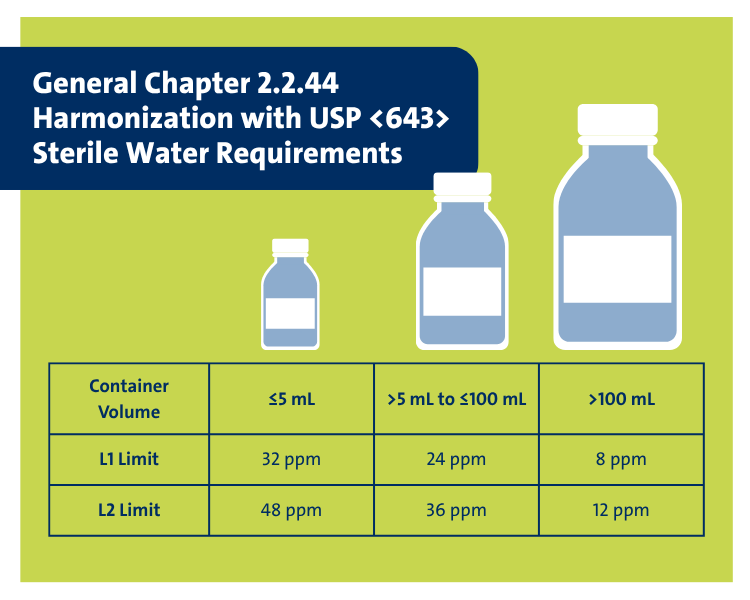
Moving towards global harmonization with the 2021 USP Sterile Water requirements, EP will retire the subjective "Oxidisable Substances" test for Sterilised Water for Injections (SWFI). Its replacement is Method B as detailed in general chapter 2.2.44. This shift provides the industry with a more precise, data-driven approach to water quality.
Download Now: European Pharmacopoeia (EP) 12.3 Regulatory Update: Adopting New TOC Standards and Container-Dependent Limits
Method B moves away from a "one size fits all" limit. TOC acceptance criteria are now determined by the nominal volume of the container. General Chapter 2.2.44 has been expanded to include "Method B," specifically for testing packaged SWFI. Under Method B, TOC acceptance criteria are no longer a single flat rate. Instead, limits are container-dependent, meaning the allowable amount of carbon varies across three specific volume tiers:
Read More: Regulations overview: USP <643> “Total Organic Carbon”
Perguntas Frequentes
Here are common questions related to changes to EP 2.2.44 Total Organic Carbon in Water for Pharmaceutical Use. Questions specific to Veolia’s line of Sievers TOC Analytical Instruments can be found at the bottom of this article.
When do changes to EP 2.2.44 Total Organic Carbon in Water for Pharmaceutical Use take effect?
The new regulations are officially being enforced as of July 1, 2026. The changes were published in the European Pharmacopoeia (Ph. Eur. 12.3) and include updates to chapters concerning Water for Injections (0169), Water, Purified (0008), and 2.2.44. Total Organic Carbon in Water for Pharmaceutical Use.
Who do these changes apply to?
These requirements apply to:
- Any company selling drug products into European countries, regardless of where the manufacturing facility is located.
- European-based companies selling within Europe and international companies that export products to Europe.
What is the actual difference between USP and EP standards if they both use sucrose and 1,4-benzoquinone?
Both the USP and EP system suitability standards sets are made of sucrose and 1,4-benzoquinone. The difference lies in where the raw materials to make the sucrose and 1,4-benzoquinone are sourced from. The raw materials used to make the sucrose and 1,4-benzoquinone for the USP system suitability standards are sourced from USP whereas the raw materials used to make the sucrose and 1,4-benzoquinone for the EP system suitability standards are sourced from the European Directorate for the Quality of Medicines & Healthcare (EDQM).
Is the calculation for pass/fail of the EP standards (i.e., Response Efficiency) different from the USP standards?
The calculations are the same.
Can I still use USP standards for EP compliance?
While it is technically possible to use USP standards, they are now classified as 'secondary standards'. If you choose to use USP standards instead of the official EP CRS, you will be required to conduct and document extensive, in-depth statistical equivalency studies to prove traceability to the EP primary standard. Failure to provide this documentation to justify your alternative material during a regulatory audit will likely result in a finding of non-compliance.
Can I use EP standards and still be USP compliant?
Customers must conduct their own in-depth validation studies to justify and defend their choice of using USP over EP or vice versa, during regulatory audits if they do not run both.
If I make my own standards in-house, what changes?
If you currently make your own system suitability standards, you can continue to do so with the new regulation change. However, it is important to note that if you need to be compliant with both USP and EP, you need to source sucrose and 1,4-benzoquinone from both USP and EDQM to make your own standards. This doubles vendor management and preparation workload. For cost effectiveness and efficiency, consider purchasing certified pre-made EP and USP system suitability standards.
What must be included in a comparison study to establish USP or in-house produced standards as an acceptable secondary standard?
To use an alternative standard for EP compliance, consider the following as part of study:
- Match Intended Use: Ensure the secondary standard exhibits the exact same properties and is used for the same purpose as the primary standard.
- Establish Identity: Formally confirm the identity against the primary standard using additional analytical techniques.
- Demonstrate Traceability and Equivalence: Establish a documented, unbroken chain of comparison through physical testing and statistical analysis.
- Assign Value and Measurement Uncertainty (MU): Assign a property value and calculate the associated MU.
- Evaluate Limits and Guard Bands: Evaluate the MU; if significant, you must apply "guard bands" to shrink the acceptance zone.
- Ongoing Requalification: Periodically requalify every new batch against the primary standard based on a written protocol.
How often should I run EP system suitability standards?
Determining frequency should be based on a risk assessment of your specific processes and the criticality of the data. The frequency needs to be determined by each company and is based on risk and criticality. Companies may already have a frequency at which they run USP system suitability standards, but they will need to decide at what frequency to add in EP system suitability standards.
If your company sells products in both the USA and Europe, you will need to run both USP and EP system suitability standards at a frequency that you can justify and defend unless you go through the secondary validation. If companies do not run both USP and EP system suitability standards, they must conduct their own in-depth validation studies to justify and defend their choice of using USP over EP during regulatory audits.
Will my TOC instrument require software updates to comply with the new standards?
The transition to EP-compliant CRS standards represents a regulatory requirement rather than a technological one. Importantly, adopting the new EP standards may not necessitate modifications to your existing analytical infrastructure. The manufacturer of your TOC instrument should be the source of truth with regards to software impacts.
For those currently using a Sievers M9 TOC Analyzer or Sievers M500 TOC Analyzer, no firmware updates are required to implement the new EP standards. Additionally, no changes to calibration or verification procedures are necessary to comply with the updated standards.
Are instrument testing protocols for EP standards different from those for USP standards?
USP and EP methods and protocols are the same, the difference being the EP materials. That said, please refer to the manufacturer of your TOC instrument. They will be the source of truth with regards to impacts to testing protocols for TOC measurement.
Questions Specific to Sievers TOC Instruments
Will my Sievers TOC instrument require software updates to comply with the new standards?
No firmware updates are required to implement the new EP standards for those using a Sievers M9 TOC Analyzer (Lab, Portable, and Online) or a Sievers M500 TOC Analyzer. Additionally, no changes to calibration or verification procedures are necessary to comply with the updated standards.
Are the testing protocols for EP standards on the Sievers TOC analyzers different from those for USP standards?
USP and EP methods and protocols are the same, the only difference being the EP materials. For those using a Sievers M9 TOC Analyzer (Lab, Portable, and Online) or Sievers M500 TOC Analyzer, there will be no impacts.
Get EP-compliant certified reference standards
To facilitate a seamless transition, Veolia now offers a full suite of Sievers EP-compliant certified reference materials, manufactured under ISO/IEC 17025 and ISO 17034. Visit this page to learn more or download our consumables catalog.
If you need to seamlessly integrate the new official EP standards into your testing processes, our knowledgeable team is here to help.
Secondary standards: Navigating in-house standard validation
Under the updated European Pharmacopoeia regulations, continuing to use in-house prepared standards requires a rigorous demonstration of equivalence. Your facility will need to perform extensive, documented statistical comparison studies to prove your materials are fully traceable to the primary EP CRS.
We are here to support your in-house validation efforts by supplying the certified EP standards you need to successfully execute these secondary standard comparisons. Contact us today to discuss the technical requirements of this study and evaluate the best compliance strategy for your facility.
Autores:
- Addie Evans
-
Addie Evans is a Global Product Manager for the Sievers consumables product line at Veolia. Prior to joining Veolia, Addie was a Product Manager at Nordson Corporation for both the Industrial systems and biopharma/surgical divisions. Addie holds a B.S. in Biochemistry from Georgia Southern University.